
Starting with the quiet moments
Every teacher has had that moment: you ask what feels like a great question, and the room suddenly becomes very interested in the walls, the floor, or the ceiling. A few confident hands go up, but many students stay quiet — not because they don’t know, but because they’re still organizing their thoughts.
Think–Pair–Share steps into that moment beautifully. It’s a simple structure, used across subjects and grade levels, that gives students time to think, space to talk, and finally the confidence to share.
What Think–Pair–Share actually looks like
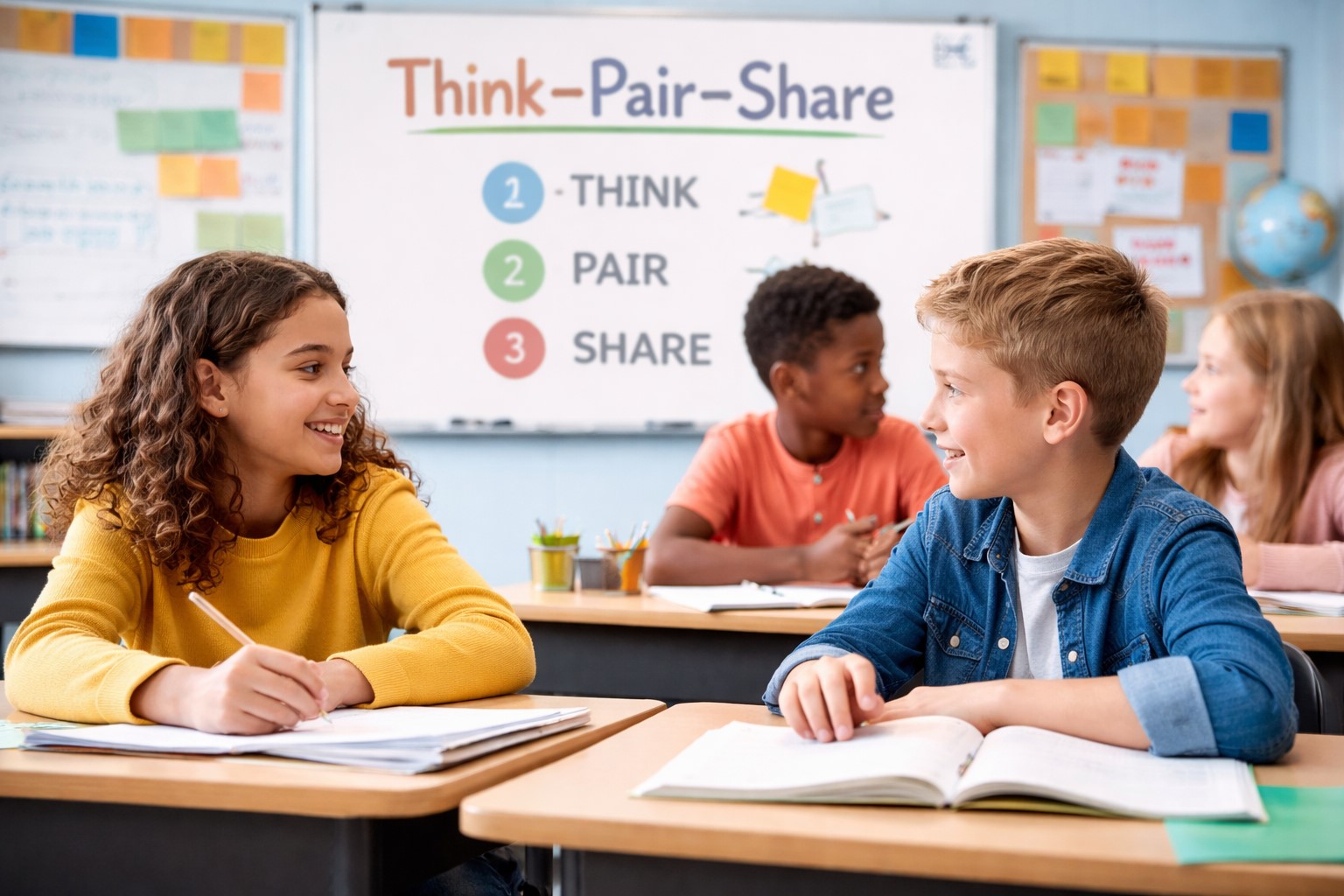
At its core, the strategy is straightforward. First, students take a short moment to think quietly about a question. Then, they turn to a partner and talk through their ideas. Finally, pairs share highlights with the class.
No extra equipment, no complicated prep. Just a clear routine that helps students move from silent thinking to shared conversation.
Where it fits in the classroom
One of the reasons teachers keep coming back to this strategy is how flexible it is. It works at the beginning of a lesson to activate prior knowledge, in the middle when you want to check understanding, or at the end as a reflective wrap-up.
In Language Arts, students might discuss why a character made a certain choice. In Science, they might predict what could happen next in an experiment. Math teachers often use it when students explain how they solved a problem, and in Social Studies, it’s perfect for talking through multiple perspectives on historical events.
Because students think first, they arrive at the conversation prepared — and that changes everything.
Why Think–Pair–Share works so well
The power of this strategy lies in its simplicity. Students move through three natural stages of learning: they process, they talk, and they listen. Quieter students — the ones who usually hesitate — suddenly have room to participate. The short pause helps everyone slow down and actually think, rather than rushing to guess.
It also strengthens confidence. Sharing an idea with one person feels much safer than announcing it to thirty. By the time students speak to the class, they’ve already tested their thinking. Teachers benefit too — listening to partner conversations reveals misunderstandings long before assessments do.
Why students tend to like it
When students talk about Think–Pair–Share, they often mention that it feels fair. Everyone gets a chance. The pressure drops, and discussions feel more like real conversations instead of mini-performances. Many students discover that explaining their thinking out loud helps them actually understand the content better.
A few simple variations
Teachers often adapt the strategy in small ways. Some use “Pair–Pair–Share,” where two pairs combine and compare ideas. Others prefer “Write–Pair–Share,” giving students a minute to jot thoughts before talking. In digital classrooms, pairing happens in chats or breakout rooms — the structure stays the same, even when the format changes.
Tips for making it work smoothly
Open-ended questions make the biggest difference. Clear expectations help too — especially reminding students that both partners should contribute. Walking the room while pairs talk lets you quietly support students who need encouragement. When it’s time to share, inviting several pairs rather than just one keeps the discussion balanced and lively. And for those who need it, sentence starters can remove a lot of anxiety.
A small strategy with a big impact
Think–Pair–Share proves that classroom engagement doesn’t always depend on complex tools or elaborate plans. Sometimes it begins with a thoughtful question, a short pause, and two students talking quietly about what they think — a simple moment that can gently draw an entire class into the conversation.

Leave a Reply